
How Gorillaz Explore Grief and Mortality On New Album ‘The Mountain’
This piece was penned by a contributor from the Genius collective.
More than two decades after their self-titled debut, Damon Albarn and Jamie Hewlett’s virtual outfit Gorillaz continues to explore imaginative and unexpected creative frontiers. On their ninth studio record, The Mountain, they embark on a transcontinental odyssey, blending their signature blend of alt-pop and hip-hop with Indian and Hindu cultural motifs to craft a profound, moving examination of loss and human mortality.
Production for the album commenced shortly after the launch of 2023’s Cracker Island. During the creative process, both artists tragically lost their fathers within a ten-day span. Hewlett, familiar with the Indian landscape through his mother-in-law’s engagement with Eastern therapeutic practices, suggested that he and Albarn travel there together as a method of processing their bereavement. The Mountain serves as the ultimate distillation of that journey.
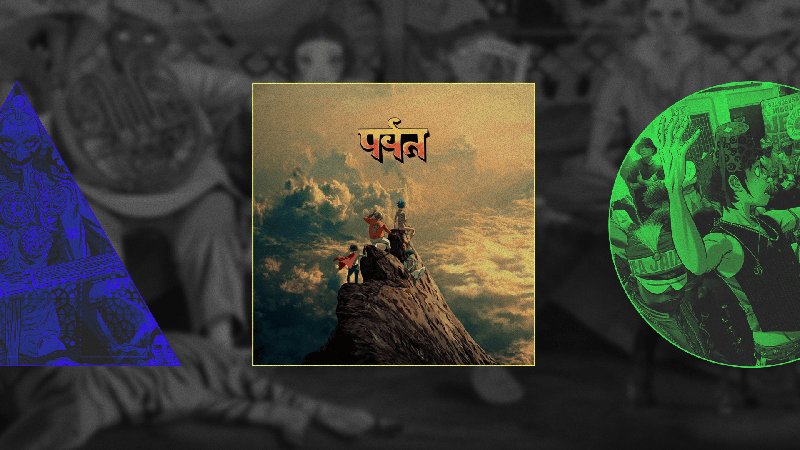
The cover art, depicting the Gorillaz ensemble—2-D, Russel, Noodle, and Murdoc—ascending a mountain peak, mirrors Albarn’s inward voyage toward reconciling with sorrow. He has reached a point of accepting life’s trajectory and the inevitability of death, a reality that confronts everyone eventually. After a four-decade career in music, Albarn finds himself grappling with the sobering experience of witnessing his contemporaries and kin pass away.
Consequently, the album initiates with its core motifs of demise and reincarnation conveyed through sound. The title track incorporates snippets from the Gorillaz archive, utilizing the voice of the late Dennis Hopper—sourced from their 2005 spoken-word piece “Fire Coming Out Of The Monkey’s Head”—repurposed so the actor repeatedly intones the word “mountain.”
The original recording, featured on the album Demon Dayz, was charged with political commentary. Accompanied by performances from world-renowned traditional Indian musicians—Anoushka Shankar, Amaan Ali Bangash, and Ayaan Ali Bangash—Hopper’s looped vocal sample imbues the lyrics with an ethereal, meditative quality, akin to a religious chant.
The mountain, the mountain
Serenity
The mountain, the mountain
The mountain, all good souls come to rest
Hopper sadly succumbed to cancer in 2010, and his demise parallels the passing of Albarn’s father from the same illness. His presence on the inaugural track as an otherworldly voice from beyond functions as a primary theme for the remainder of The Mountain, as Albarn invokes the spirits of various other collaborators who left this world abruptly.
Another striking example is the rapper Proof (well-known for his role in D12), featured on “The Manifesto.” His verse is lifted from a freestyle recorded during their 2001 collaboration on the single “911”, and it serves as the centerpiece for a shift in the song’s rhythm that carries a haunting, ritualistic atmosphere, reminiscent of a spiritual summoning.
You never seen a killer with fangs and millimetres that bang
And killers need to be swangin' and still I reach ya
Y'all aren’t ready for death until I showed up
Proof’s contribution is characteristically filled with grim allusions to brutality and passing, which carry a deeper weight given that Proof was fatally shot in his hometown of Detroit in 2006.
The gesture of revisiting past collaborators to construct a sort of artistic retrospective mirrors a person contemplating their own existence as they face their final days. Hewlett elaborated on this creative decision during an interview with Rolling Stone.
“I wanted to incorporate [the past collaborators] into the dialogue so the record encompasses everyone and the entirety of the band’s legacy,” he stated. “[It feels as if they are] speaking from the other side.”
Other late Gorillaz alumni who surface on The Mountain through sampling include Bobby Womack, Lou Reed, Tony Allen, Mark E. Smith, and Trugoy the Dove of De La Soul. Most of these samples were retrieved from the Plastic Beach recording sessions, excluding the excerpt of Tony Allen speaking in Yoruba, which originates from the song “How Far?”, found on the 2020 project Song Machine, Season One: Strange Timez.
Oya, ẹ dide, ẹrori
Oya, ẹ dide, ẹrori
Oya, ẹ dide, ẹrori
The perspective that life and death are indivisible stages of a single continuum is a foundational tenet in Hindu and Indian philosophies. “Karma” represents the perpetual flow of existence and rebirth, where death marks not an end, but merely a transition. “This contrasts sharply with Western ideology, where most people believe they possess total autonomy over their fate,” observes scholar Rashmi Gupta in a study published in Death Studies. “Consequently, someone who subscribes to the notion of individual agency is prone to deeper suffering when grieving a loved one.”
Following his father’s passing and his time exploring India, Albarn utilizes this record to navigate these conflicting viewpoints. It is, ultimately, a vibrant celebration of existence. Beyond the Eastern-inspired arrangements and aesthetics, the lyrical content of The Mountain also weaves in Hindu references. “The Plastic Guru” drew from Albarn’s experience with a superficial iteration of the faith, while rapper Black Thought manages to include various allusions on “The Empty Dream Machine.” He concludes his verse with a nod to Krishna, a primary deity in Hinduism whose philosophy deeply informed concepts of the afterlife and reincarnation.
On the mountain top is a wonderland like it was Alice
So every blood vessel expand, forbidden talents
Doin' tantric downward, a gold tooth in a trash can
Was the beginnin' of me kinda takin' my last stand
When I was Wimbledon, they tried to swing me the back hand
Part of the pendulum and do me like I’m a Black man
That’s Black-like spirits, Black-like Krishna
Or Black like a deity that’s trapped like a prisoner
While the Gorillaz maintain their characteristic air of mystery, this album stands out for the profound intimacy of its themes. Regardless of the dense symbolism and cross-cultural layers—and the fact that it remains a cartoon band—a track like “The Hardest Thing” (and its accompanying sequel, “Orange County”) pierces through to the human essence of the work.
With minimalist instrumentation and a recurring melody, Albarn contemplates the life and legacy of his father, who profoundly influenced Damon’s early introduction to arts and culture, particularly during the family’s time living in a predominantly Indian and Pakistani neighborhood in London.
You know the hardest thing
Is to say goodbye to someone you love
That is the hardest thing
And when the curtains rise
And the party begins
Do you love?
Do you pray?
Down inside
Wondering how
How you got to the afterlife?
The Mountain serves as a unique landmark for a musical venture that has endured far longer than most observers expected. By weaving together diverse temporal arcs, sonic textures, and thematic inquiries, Albarn and Hewlett invite their audience to join them on this spiritual voyage, ensuring that, together, we might find a measure of tranquility amidst our mourning.
