It’s mid-February in New York City and Madison Square Garden is packed to capacity with onlookers. Devotees and famous faces gather for the unveiling of Kanye West’s Yeezy Season 3 collection, which served as a listening session for his highly anticipated seventh studio record, The Life of Pablo. The duration of 2 years, 7 months, and 27 days separating that release from its predecessor, 2013’s Yeezus, represents the longest hiatus in West’s prolific career to date.

The rapper makes his way to the center of the arena much like a prizefighter entering the squared circle, accompanied by then-G.O.O.D Music President Pusha T, Travis Scott, and a host of other intimate collaborators who contributed to the project’s development. To launch what could be described as the world’s most massive house party, West connects his laptop to the venue’s sound system to unveil his next creative chapter to the world.

Despite the high-profile launch, the public wouldn't hear The Life of Pablo until the early hours of February 14, and it appears Ye worked on the material right up to the final second. In the four months that ensued, West would refine more than a dozen songs, incorporating everything from updated vocal mixes and lyrical tweaks to entirely original tracks.

The Life of Pablo reaches its ten-year milestone this week. This release signified a transformative period in the life of its creator. It was his first major project as a father and spouse, and it saw him delving more deeply into the realm of gospel music. It also emerged during a time of significant personal turmoil regarding his mental well-being. Ultimately, the album serves as a perfect summary of West: a perpetual work-in-progress.

“My previous record was protest art,” West noted in an early 2015 conversation with The Breakfast Club. “This project is purely about embracing the music, welcoming joy, and serving the people.”

By 2015, the successor to West’s Yeezus was shaping up to be quite different from the final version. Potential singles like “Only One,” “FourFiveSeconds,” and “All Day” carried forward the sharp minimalism and stripped-back production style found throughout Yeezus. Interestingly, all three were crafted in partnership with Paul McCartney. Ultimately, these cuts didn't make the final tracklist for The Life of Pablo, and in retrospect, they act more like symbols of a transitional phase between the two records.

So Help Me God, Swish, and Waves were all titles West considered before finally settling on the esoteric The Life of Pablo, which reflected Ye’s sonic vision for the collection. In an interview with Real 92.3’s Big Boy, Kanye described it as “a gospel record containing a whole lot of profanity.”

“It’s the gospel according to ‘Ye,” he remarked. “Not strictly a retelling of Biblical events, but rather a narrative exploring the concept of Mary Magdalene evolving into Mary.”

This sentiment was evident from the very first track, as Kanye enlisted The-Dream, Kelly Price, Chance the Rapper, Kirk Franklin, and a ten-person choir for the atmospheric “Ultralight Beam.” The track represents a shift away from the Yeezus anthem “I Am a God,” moving from him declaring himself a deity to worshipping the King of Kings. In a discussion with The Fader, co-writer Fonzworth Bentley revealed that the chorus came to West during a freestyle session.

We on an ultralight beam
This is a God dream
This is a God dream
This is everything
This is everything

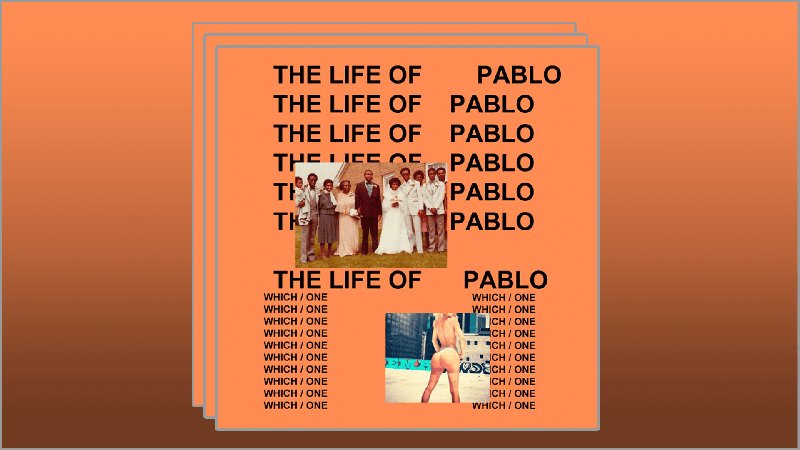
There is no definitive explanation regarding which “Pablo” Kanye named the record after. The cover art even poses the question “WHICH/ONE.” However, Kanye’s “beam” imagery alludes to the biblical transformation of Saul into Saint Paul the Apostle. Blinded by a divine radiance while en route to Damascus, Saul spent three days in shadow before committing himself to the Lord and penning 13 books of the New Testament. Kanye employs this metaphor to mirror the initial phases of his own spiritual awakening, which would later feature prominently on his subsequent records JESUS IS KING and DONDA.

“Ultralight Beam” also serves as a symbolic passing of the torch to the next generation of Chicago hip-hop, with Chance the Rapper delivering a triumphant verse in what looked like the dawn of a significant mentor-mentee bond between the two artists. (Spoiler alert: That didn't last.)

I made “Sunday Candy,” I’m never going to hell
I met Kanye West, I’m never going to fail
He said, “Let’s do a good ass job with ‘Chance 3’”
I hear you gotta sell it to snatch the Grammy

On the record’s notorious debut single, “Famous,” Kanye brings in Rihanna and Swizz Beatz to reopen old wounds over a Havoc-assisted beat, sampling and interpolating classics from Nina Simone and Sister Nancy, with Rihanna singing the hook from Simone’s iconic “Do What You Gotta Do.” He ignited genuine controversy with a line addressing pop superstar Taylor Swift.

I feel like me and Taylor might still have sex
Why? I made that bitch famous (Goddamn)
I made that bitch famous

This lyric immediately rekindled the near-decade-long conflict between West and Taylor Swift, which sparked when the rapper interrupted her acceptance speech for Best Female Video at the 2009 MTV Video Music Awards. Although Kanye claimed he had obtained Swift’s permission before dropping “Famous”—with his then-spouse, Kim Kardashian, releasing a recorded phone chat that appeared to suggest Taylor had given her consent—Swift contended that West never shared the “I made that bitch famous” line. Many critics labeled Taylor as playing the victim, yet once the complete audio of the call was made public, it exonerated Swift, confirming she was unaware of the offensive term.

Elsewhere on “Famous,” we see an early instance of post-release modifications. Only days following the track’s radio debut, the lyric “She be Puerto Rican day parade waving” was changed to “She in school to be a real estate agent.”

Kanye had hinted at mental health challenges on prior albums, but The Life of Pablo brought them into sharp focus. The release occurred during a volatile period in West’s life. The associated tour was canceled after the musician endured a nervous breakdown while performing in Sacramento, leading to his subsequent hospitalization.

On “FML,” featuring The Weeknd, West strips away his massive public persona for a moment of brutal honesty. Now a family man, he balances on the tightrope between his reputation as a visionary and the medicinal support required to keep him steady.

You ain’t never seen nothing crazier than
This nigga when he off his Lexapro
Remember that last time in Mexico?
Remember that last time, the episode?

On “No More Parties in LA,” likely the only instance where Kendrick Lamar has been lyrically outperformed on a song, Kanye and his Yeezus Tour opening act trade lengthy verses over a mellow Madlib production. West’s verse, penned during a flight to Italy, spans an impressive 90 bars. The rapper invites us into the mystique of “Pablo,” with lines referencing Pablo Picasso, Pablo Escobar, and Paul the Apostle, frequently known as Saint Pablo.

I feel like Pablo when I’m workin' on my shoes
I feel like Pablo when I see me on the news
I feel like Pablo when I’m workin' on my house
Tell ‘em party’s in here, we don’t need to go out

West has claimed to have recorded 40 tracks alongside Kendrick, although this remains the solitary official release. (Lamar also holds a writing credit on 2015’s “All Day.”)

Kanye began refining The Life of Pablo as early as March 2016. Ever the perfectionist, Kanye tweaked over a dozen songs between then and June, effectively rewriting the standards for how an album and its promotional cycle could function. After the aforementioned lyrical revision on “Famous,” Kanye added Sia and VIC MENSA to “Wolves,” both of whom had been featured when Ye introduced it on Saturday Night Live. In the process, Kanye treated us to his famous “Ima fix wolves” tweet.

Life Of Pablo is a living, breathing, and ever-evolving artistic statement,” West would explain following the initial updates.

The final addition to The Life of Pablo, “Saint Pablo,” arrived four months following the primary release. Over a synth-driven remix of Jay-Z’s “Where I’m From,” Kanye plays into antisemitic tropes (“The Jews share their truth on how to make a dime, Most Black men couldn’t balance a checkbook.”) while minimizing his personal struggles as mere side effects of his “brilliance.”

This generation’s closest thing to Einstein
So don’t worry about me, I’m fine
I can see a thousand years from now in real life
Skate on the paradigm and shift it when I feel like

“Nothing is ever truly finished,” West remarked to GQ regarding The Life of Pablo and its subsequent adjustments in a 2020 interview. Since its debut, so much has transpired that it warrants a follow-up to “I Love Kanye,” the Pablo track where West infamously raps, “I miss the old Kanye.” Kanye has since fluctuated between medications, become a born-again Christian, welcomed two children, gone through a divorce, remarried, embraced neo-Nazi rhetoric, denounced his extremist views, and much more.

At the time, The Life of Pablo served as the ultimate conflict between “the old Kanye” and “the new Kanye,” and it was perhaps the final era when we all felt genuine affection for him. Its chaotic rollout and constant revisions reflect West’s own human journey, reinforcing the notion that it is never too late for a fresh start, reinvention, or a quest for redemption. The only consistency throughout the life of Ye has been his total unpredictability.